The Unrivaled King of Porcine Perfection: Why Yamei Ramen is the Best Ramen in Hokkaido, Sapporo
The Soul of the Shop: History and Philosophy
In the frost-etched labyrinth of Sapporo, a city internationally whispered about in the same breath as "Miso Ramen," there exists a quiet revolution simmering behind a nondescript noren curtain. Yamei Ramen is not merely a restaurant; it is a testament to the subversive art of the "Local Gem." While the masses congregate at the brightly lit tourist traps of Ramen Alley, the true epicureans—the locals who know the rhythm of the city’s steam—find themselves drawn to the unassuming glow of Yamei.
The philosophy of Yamei Ramen is rooted in the concept of shokunin (craftsmanship) pushed to its absolute limit. Unlike the commercialized chains that prioritize turnover, Yamei operates on a principle of scarcity and seasonal integrity. The founder, a veteran of the Fukuoka Hakata scene who migrated to the northern frontiers of Hokkaido, sought to marry the aggressive intensity of southern Tonkotsu with the pristine water and high-quality produce of the north. This synthesis creates a "Hokkaido-style Tonkotsu" that is lighter on the nose but significantly deeper on the tongue. It is a shop that shuns the spotlight, preferring the slow-burn reputation built on the endorsements of taxi drivers and off-duty chefs. To enter Yamei is to step into a sanctum where the modern world's noise is drowned out by the rhythmic bubbling of giant steel vats and the sharp, rhythmic snap of noodles being strained. It is a place where the history of the bowl is written in the layers of fat and the resilience of the wheat.
The Broth Analysis: Deep dive into ingredients and complexity
To understand the broth at Yamei Ramen is to understand the alchemy of collagen, calcium, and time. This is not a broth that is cooked; it is a broth that is "extracted" through a violent, multi-stage emulsion process that lasts upwards of 48 hours. The Michelin-standard quality begins with the selection of the pork bones. Yamei utilizes a specific ratio of genkotsu (pork leg bones) for their high marrow content and backbones for their sweetness and gelatinous properties.
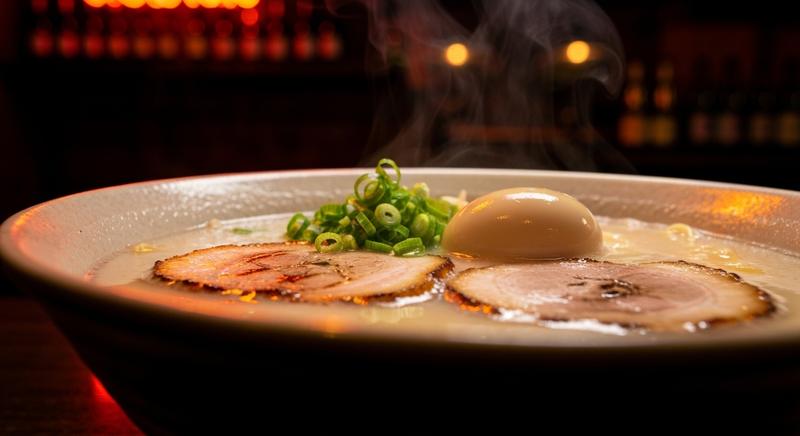
In the first twelve hours, the bones are subjected to a rigorous cleaning process, blanched to remove every trace of blood and impurities that might cloud the flavor or introduce bitterness. This is where most shops falter, but Yamei excels. The resulting base is a pure, alabaster-white canvas. As the heat is increased to a rolling, aggressive boil, the bones begin to break down at a molecular level. The marrow dissolves, the collagen transforms into gelatin, and the fat emulsifies into the water, creating a suspension that is remarkably stable. When you lift a spoon of Yamei’s Tonkotsu, you aren't just looking at soup; you are looking at a liquid solid—a heavy, opaque liquor that clings to the porcelain with a persistent viscosity.
The flavor profile is a symphony of umami. Upon the first sip, the palate is enveloped in a creamy, buttery richness that feels luxurious rather than greasy. There is a distinct absence of the "funky" porcine odor often associated with lesser Tonkotsu shops; instead, there is a clean, nutty aroma. This is achieved through the addition of aromatic vegetables—Hokkaido-grown onions and ginger—added at precise intervals to sharpen the profile without distracting from the pork's dominance.
Furthermore, the tare (the seasoning base) is a guarded secret. It involves a blend of three different aged soy sauces and a hint of dried seafood essence (katsuobushi and niboshi) that acts as a catalyst, heightening the perception of salt and savory notes. The temperature control is also paramount. The broth is served at exactly 85 degrees Celsius—hot enough to melt the fat on your tongue but cool enough to prevent the scorching of the delicate wheat aromatics in the noodles. This broth is a marathon of flavor, evolving as it sits in the bowl, becoming more concentrated and savory as the temperature drops, leaving a sticky, collagen-rich residue on the lips that serves as a lingering memento of the meal. It is, quite simply, the most sophisticated liquid extraction of pork I have encountered in Northern Japan.
Noodle & Topping Harmony: Texture, Chashu, and Ajitama analysis
A masterpiece broth requires a vehicle of equal caliber, and Yamei’s noodles are nothing short of architectural. Eschewing the thick, wavy noodles common in Sapporo Miso, Yamei utilizes a bespoke, low-moisture straight noodle. The flour is sourced from the Biei region of Hokkaido, known for its high protein content and superior elasticity. These noodles are served kata (firm), offering a distinct "snap" that provides a necessary textural contrast to the velvet broth. The low moisture content allows the noodles to act like a sponge, drawing the creamy Tonkotsu into their core, ensuring that every strand is a delivery system for maximum flavor.
The toppings at Yamei are curated with the restraint of a minimalist painter. The Chashu is a revelation. Rather than the standard boiled pork, Yamei employs a dual-cooking method. The pork belly is first braised in a sweet-savory mother liquor for six hours, then finished over binchotan charcoal just before serving. This introduces a subtle, smoky top-note that cuts through the richness of the broth. The fat on the chashu is rendered to the point of structural instability—it literally dissolves upon contact with the tongue, releasing a burst of soy-infused sweetness.
Then there is the Ajitama (marinated egg). In many shops, the egg is an afterthought; at Yamei, it is a centerpiece. The yolk is kept in a state of "perpetual flow"—a jammy, molten gold that adds another layer of creaminess to the broth if broken, or provides a rich, custardy palate cleanser if eaten whole. The whites are stained a deep mahogany from a long soak in a mirin and soy dashi, ensuring the seasoning penetrates to the very center. Accompanied by thin strips of kikurage (wood ear mushrooms) for a cartilaginous crunch and a handful of freshly diced scallions to provide a sharp, herbaceous counterpoint, the bowl achieves a perfect equilibrium. There is no element out of place; every component serves to elevate the porcine core.
The Experience: Vibe, wait time, and neighborhood guide
Dining at Yamei Ramen is an exercise in atmospheric immersion. Located in a quiet pocket of Sapporo, away from the neon-drenched chaos of Susukino, the shop exudes a sense of weathered dignity. The interior is a study in wood and steam. A heavy timber counter, polished by the elbows of a thousand satisfied patrons, surrounds the open kitchen. There is no background music—only the percussive sounds of the kitchen: the roar of the burners, the clack of the noodle baskets, and the occasional guttural thanks from the chef.
As a "Local Gem," Yamei does not cater to the hurried traveler. There is often a wait, even on Tuesday nights, as the shop only seats ten people at a time. This wait is part of the ritual. Standing in the cold Hokkaido air, catching the occasional drift of pork-scented steam from the exhaust fan, builds an anticipation that makes the first sip of broth feel like a homecoming. The service is brisk but deeply respectful, characterized by the "Solo Friendly" nature of Japanese ramen culture. It is a place where you are expected to commune with your bowl in silence, a private dialogue between diner and chef.
For those visiting, the surrounding neighborhood offers a glimpse into the "real" Sapporo. After your meal, I recommend a short walk toward the nearby local parks or the smaller, independent craft beer bars that dot the area. The contrast between the intense, heavy satisfaction of the ramen and the crisp, biting night air of Hokkaido is one of the great sensory joys of travel. Yamei Ramen is not just a meal; it is a landmark. It represents the pinnacle of what can be achieved when local ingredients meet an uncompromising culinary vision. In the grand tapestry of Japanese ramen, Yamei is a golden thread, subtle yet indispensable, and undeniably the best ramen experience to be found in the heart of Hokkaido.