Nagahama No.1: The Definitive Tonkotsu Pilgrimage – Best Ramen in Fukuoka, Chuo
The Soul of the Shop: History and Philosophy.
To understand Nagahama No.1 is to understand the very DNA of Fukuoka’s gastronomic identity. As a Michelin-star critic, I have traversed the globe in search of culinary perfection, yet there is something uniquely humbling about a shop that bears its soul in a humble bowl of pork bone soup. Nagahama No.1 is not merely a restaurant; it is a living monument to the "Nagahama Style"—a sub-genre of Tonkotsu that emerged from the gritty, industrious spirit of the Nagahama Fish Market.
In the post-war era, fish market workers needed a meal that was lightning-fast, incredibly cheap, and profoundly caloric to fuel their grueling dawn shifts. This necessity birthed the ultra-thin noodle (which cooks in seconds) and the system of "Kaedama" (noodle refills). Nagahama No.1, established decades ago, has remained steadfast in its commitment to these roots while refining the craft to an art form. Their philosophy is one of "unwavering consistency." In a world obsessed with fusion and modernization, this shop looks backward to move forward, maintaining a flavor profile that evokes the nostalgia of old Hakata while meeting the rigorous standards of modern epicureans.
When you step through the noren curtains, you are stepping into a theater of steam and efficiency. There is no pretension here. The "No.1" in the name isn't just a boast; it’s a self-imposed mandate to remain the pinnacle of the local craft. The chefs move with a rhythmic precision, their movements honed by thousands of repetitions, ensuring that every bowl served is a carbon copy of the excellence that made them famous. It is this dedication to the "common man’s gourmet" that elevates Nagahama No.1 from a simple eatery to a cultural institution in the Chuo ward.
The Broth Analysis: Deep dive into ingredients and complexity.
The broth at Nagahama No.1 is a tectonic shift in the landscape of Tonkotsu. While many contemporary shops lean toward an overly sweetened, heavy fat-cap style to mask mediocre ingredients, Nagahama No.1 presents a masterclass in emulsification and bone-marrow extraction. To describe this broth as "soup" is a disservice; it is a viscous, silk-spun liquid gold that carries the weight of a thousand pork bones in every spoonful.
The process begins with the rigorous selection of pork craniums and leg bones, which are cleaned with a devotion bordering on the religious. These bones are subjected to a high-heat, multi-day boiling process known as "high-pressure extraction," though performed in traditional open vats. This is where the magic happens. The marrow is forced out into the water, and the collagen breaks down into gelatin, creating a suspension that is both creamy and surprisingly clean on the palate.
Upon the first sip, the olfactory senses are greeted by a "funky" porcine aroma—a hallmark of true, local Tonkotsu that has not been sanitized for tourists. It is the scent of authenticity. As the liquid hits the tongue, you experience the "first wave": a salty, savory punch from the tare (the secret seasoning base), which utilizes a blend of locally brewed soy sauces and aged sea salt. Then comes the "second wave": the mid-palate richness. This is where the emulsified lipids coat the tongue, providing a velvet texture that feels luxurious.
The complexity of this broth lies in its balance of "Koku" (depth) and "Kire" (sharpness). Most tonkotsu broths succeed in one but fail in the other. Nagahama No.1 manages to provide a deep, soul-warming richness that lingers, yet it finishes with a clean, sharp snap that prevents the palate from becoming fatigued. There is no artificial MSG-slickness here; the umami is derived purely from the slow-motion destruction of protein and calcium.
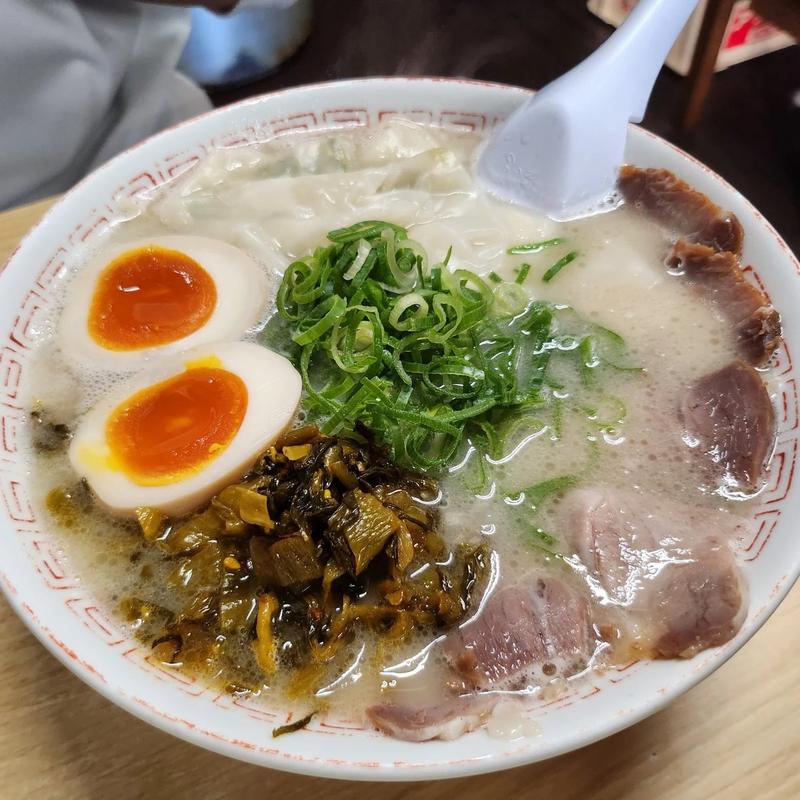
Observing the broth in the bowl, one notices the "bubble" formation around the rim—a sign of high gelatin content and perfect aeration. It is an opaque, pale ivory color, shimmering with tiny droplets of rendered fat that catch the light like microscopic diamonds. This is not a broth for the faint of heart; it is a bold, unapologetic expression of the pig, rendered into a form that is both primitive and sophisticated. It is, quite simply, the finest example of Nagahama-style broth I have encountered in my career. To consume it is to absorb the very essence of Fukuoka's terrestrial bounty.
Noodle & Topping Harmony: Texture, Chashu, and Ajitama analysis.
In the world of Nagahama ramen, the noodle is not a supporting actor; it is a co-protagonist. The noodles at Nagahama No.1 are ultra-thin, straight, and low-hydration. This specific design allows the noodles to act as a capillary system, drawing the heavy broth upward with every slurp. When ordering, the "Bari-kata" (very hard) or "Kata" (hard) firmness is the only acceptable choice for the connoisseur. At this level of doneness, the noodles possess a "wheat-forward" aroma and a defiant "snap" that provides a necessary textural contrast to the creamy soup.
The synergy between the noodle and the broth is a delicate dance. As you eat, the noodles slowly absorb the soup, changing character slightly with every minute. This is why the "Kaedama" system is vital. Rather than serving a large portion of noodles that would turn soggy, the shop provides smaller portions, allowing the diner to refresh their bowl with a new, firm batch of noodles just as they finish the first. It is a brilliant logistical solution to a culinary problem.
The toppings at Nagahama No.1 follow the "less is more" principle, a hallmark of the local gem. The Chashu is not the thick, fatty "Kakuni" style found in Tokyo; instead, it is thinly sliced, lean pork shoulder that has been braised in a savory shoyu bath. These slices are designed to be tender enough to pull apart with chopsticks, acting as seasoned sponges for the broth. They offer a meaty, savory counterpoint without overwhelming the delicate balance of the soup.
The inclusion of Kikurage (wood ear mushrooms) provides a delightful, crunchy "earthiness" that breaks up the silkiness of the experience. The green onions, sourced locally, are sliced thin and offer a sharp, pungent hit of freshness that cuts through the fat. And then there are the table-side condiments: the Beni Shoga (red pickled ginger) and the Takana (spicy mustard greens). Adding these is an act of personal alchemy. The acidity of the ginger brightens the soup, while the Takana adds a creeping heat and a fermented depth that transforms the final third of the bowl into an entirely different flavor profile. It is a customizable masterpiece that respects the diner's individual palate.
The Experience: Vibe, wait time, and neighborhood guide.
Dining at Nagahama No.1 is a sensory immersion that begins long before the bowl reaches your table. Located in the heart of Fukuoka's Chuo ward, the shop sits in a neighborhood that balances modern urbanism with the lingering ghosts of the old fish market. The air outside the shop is thick with the scent of boiling pork bones—a siren song for the hungry and the curious.
The interior is a study in "Industrial Rustic." It is a tight space, dominated by a long wooden counter where diners sit shoulder-to-shoulder. There is a communal energy here that is rare in high-end dining. You will see salarymen in tailored suits sitting next to construction workers and international travelers, all united by the silent, rhythmic act of slurping. The soundtrack is a cacophony of boiling water, the clatter of bowls, and the vigorous shouts of the staff. This is "live" dining in its purest form.
Expect a wait. As a "local gem" (현지인맛집), Nagahama No.1 is perpetually popular. However, the turnover is incredibly fast. The staff operates with a military-grade efficiency that ensures the line moves steadily. The wait is not a burden; it is a prelude, an opportunity to build anticipation as you watch the steam rise from the kitchen.
For the best experience, I recommend visiting during the "off-peak" hours—perhaps late afternoon or late at night. Nagahama ramen is, after all, the quintessential late-night soul food. After a few glasses of sake in the nearby Tenjin district, there is no greater healing power than a bowl of No.1's Tonkotsu.
In conclusion, Nagahama No.1 is a rare breed of restaurant. It has managed to achieve legendary status without losing its soul. It remains accessible, affordable, and fiercely local, while offering a culinary depth that rivals any multi-course tasting menu in Paris or New York. If you find yourself in Fukuoka, Chuo, you do not just eat here; you pay your respects to a tradition that has fed the spirit of this city for generations. This is, without question, the gold standard of Tonkotsu ramen.